KNOWLEDGE AND THE KNOWER—TOOLS
REMEMBRANCE OF THINGS PAST

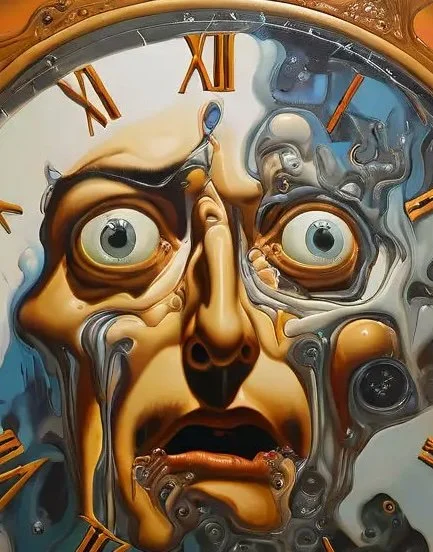
Salvador Dalí (1931) The Persistence of Memory. Oil on canvas. Museum of Modern Art, New York.
IB Psychology students encounter the “Multi-store,” “Working Memory,” and “Levels of Processing” models for memory. The class activities on this page adopt a less technical approach—incorporating a narrative, literary dimension. The unit builds on The unreliability of eyewitness reporting in the Knowledge and the Knower core theme.
CLASS ACTIVITY I —
MEMORY AND IDENTITY
Ask student volunteers to read aloud the Proust quote and the strange case of Kent Cochrane’s episodic amnesia. Finally, watch the Memento (2001) movie trailer.
Just a Minute Ask student volunteers to read aloud the Proust quote and the strange case of Kent Cochrane’s episodic amnesia. Finally, watch the Memento (2001) movie trailer.
Ask student volunteers to read aloud the Proust quote and the strange case of Kent Cochrane’s episodic amnesia. Finally, watch the Memento (2001) movie trailer. This should generate meta-thinking and lively class discussion about Identity and Memory. The following generative questions may, or may not, add value:
To what extent is a functional memory for the construal of experience necessary to maintain a sense of identity?
In Memento (2001) is the Lenny character a non-person?
No doubt many students will choose to revisit the Memento movie in the following days their own time.
1.PROUST’S MADELEINE CAKE

From Stéphane Heuet's graphic novel version of Marcel Proust's masterwork In Search of Lost Time: Swann's Way.
The reliability of Memory usually correlates directly with the vividness of the remembered experience and its nearness in time. This is not always the case. Our olfactory sense, at times, can appear to be a direct, primal, involuntary conduit to episodic memory. In literature, Proust's protagonist is instantly transported to a realm full of nostalgic sentiment and poetic detail of childhood preoccupations by the taste of a single crumb of madeleine cake soaked in lime-flavored tea.
“When from a long-distant past nothing subsists, after the people are dead, after the things are broken and scattered, still, alone, more fragile, but with more vitality, more unsubstantial, more persistent, more faithful, the smell and taste of things remain poised a long time, like souls, ready to remind us, waiting and hoping for their moment, amid the ruins of all the rest; and bear unfaltering, in the tiny and almost impalpable drop of their essence, the vast structure of recollection.
And once again I had recognized the taste of the crumb of madeleine soaked in her decoction of lime-flowers which my aunt used to give me (although I did not yet know and must long postpone the discovery of why this memory made me so happy), immediately the old gray house upon the street, where her room was, rose up like the scenery of a theater.”
2. EPISODIC AMNESIA

Dr. Endel Tulving interviewing amnesic patient Kent Cochrane, who was involved in a motorcycle accident that left him with permanent severe amnesia.
The outstanding fact about K.C.'s mental make-up is his utter inability to remember any events, circumstances, or situations from his own life. His episodic amnesia covers his whole life, from birth to the present. The only exception is the experiences that, at any time, he has had in the last minute or two… The impairment does not encompass only the past; it also extends to the future. Thus, when asked, he cannot tell the questioner what he is going to do later on that day, or the day after, or at any time in the rest of his life. He cannot imagine his future any more than he can remember his past. This aspect of the syndrome he presents suggests that the sense of time with which autonoetic consciousness works covers not only the past but also the future... Mental time travel involves awareness not only of what has been but also of what may come.
Endel Tulving (2002) Episodic Memory: From Mind to Brain. Annual Review of Psychology. 53:1-25,
3. MEMENTO (2001)
CLASS ACTIVITY II —
consequences of total recall
Not all experiential events are of equal weight. Our conscious experience generates mountains of chaff. We know that memory is necessarily selective. How do we distinguish between what is important and what is trivial?
The following extract from the Borges short story Funes the Memorius explores the dire consequences of having total recall. The tale is really an ad absurdum thought experiment, rather like his short piece On Exactitude in Science that is featured at the beginning of the TOK course in The Map is Not the Territory.
On falling from the horse, he lost consciousness, when he recovered it, the present was almost intolerable it was so rich and bright; the same was true of the most ancient and trivial memories. A little later he realized he was crippled. This fact scarcely interested him. He reasoned (or felt) that immobility was a minimum price to pay. And now his memory and perception were infallible…
Funes not only remembered every leaf on every tree of every wood. But even every one of the times he had perceived or imagined it…
…the dizzying world of Funes. He was, let us not forget, almost incapable of general, platonic ideas. It was not only difficult for him to understand that the generic term dog embraced so many unlike specimens of differing sizes and different forms; he was disturbed by the fact that a dog at three-fourteen (seen in profile) should have the same name at three-fifteen (seen from the front). His own face in the mirror, his own hands, surprised him on every occasion…
I suspect… that he was not very capable of thought. To think is to forget a difference, to generalize, to abstract. In the overly replete world of Funes there were nothing but details.
Extract from the surrealist short story Funes the Memorious from the 1941 collection Ficciones by Jorge Luis Borges.
ENDNOTES
Imagination seems inextricable from memory.
Compelling evidence for this comes from brain-damaged, amnesiac patients like, Kent Cochrane, who can no sooner relate what they will do in the future, than recall what happened just a few minutes previously. Such patients appear fully aware, articulate, and quite cheerful in the present moment.
Our lived experience feels anticipatory.
We are always primed for action, always on a forward cognitive trajectory. We project a fictive “what if?” from a highly edited “thus far.” As a consequence, the past and the future always seem somehow to be right there with us, constantly updated and reinvented on the fly. It seems that to a large degree we live in the subjunctive tense!
GROUP THREE:
There are no “naked perceptions”―why? Think deeply about this next question: is all seeing, seeing as? Active sense perception
Interpretation—what’s happening?
rearrange, and reframe, the new things we encounter to render them accessible—to make them fit, make them our own! We learn and adapt as we go—constructing useful fictions—large and small, capable and fallible—that, at least for the interim, appear fit for purpose, and cohere with our (co-authored) life stories.
TOK and metacognitive possibilities
All students are in medias res. There are no entirely blank slates in the room even when a brand new topic is being introduced. All students have some prior knowledge which brings losses as well as gains. Myths, folk theories and erroneous intuitions may initially block the way. Neuroscience informs us that lasting progress is more like building, repairing, pruning and strengthening the connections of a web, than climbing up the steps of a ladder. Understanding is deep learning that is built over time. Strange as it seems, a good deal of understanding seems to be reconstructed in the moment, on the fly, based on fragmentary cues and half remembered contexts. A lot of everyday experience feels like this.
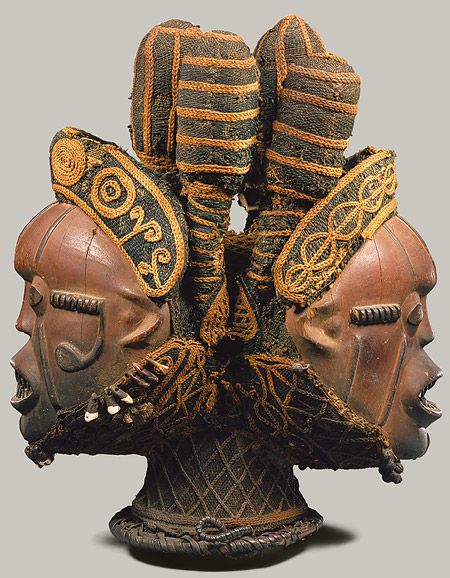
Janus headdress of the Boki from Nigeria. (19th–20th century) African collection. The Met, New York.
A Janus-like deity has arisen in many cultures. There are two faces. One looks to the future, the other, to the past. Janus can represent beginnings and endings, rites of passage, gateways, transitions, duality, and the passage of time.